Weighing only 12 kilos and standing 250 cm tall, it’s a portable piece that defies conventional sculpture concepts. It explores themes of identity and transformation, highlighting the relationship between the human body and the surrounding space.

Weighing only 12 kilos and standing 250 cm tall, it’s a portable piece that defies conventional sculpture concepts. It explores themes of identity and transformation, highlighting the relationship between the human body and the surrounding space.


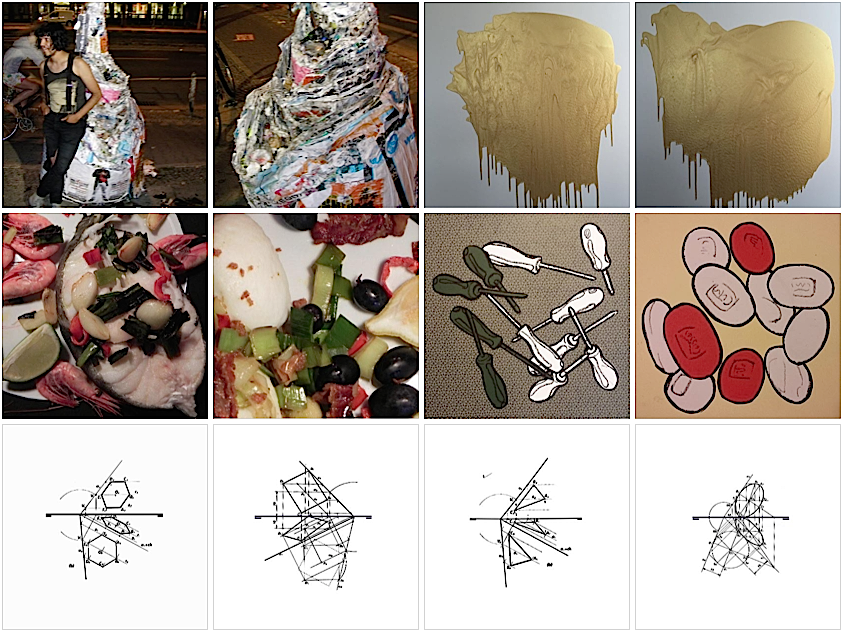


The series Endemic Monochromes articulates an urban chromatic synthesis where the city emerges not only as a physical environment but as a living, vibrating matrix of monochromatic intensities, captured and ordered through a procedural and fragmentary installation strategy that derives from the intersection of three key series developed between 2012 and 2013: first, the synthetic reduction of TWINS, a dispersed multiform installation in which the city itself becomes an immense hyperplastic entity, condensed through dual-image modules captured in cities such as London, Madrid, Marseille, Nice, Basel, Berlin and Mexico City; second, the radical use of the urban object as monochrome unit, extending prior experiments in LAPIEZA and performative collaborations with Paula Lloveras into dynamic, moving-image contexts; third, the application of the 12X file matrix, previously explored in the FILMADOS and HIPERVÍNCULOS series, serving here as a structural and conceptual chassis. The visual result is a dense grid of double frames, where everyday objects, walls, wires, pipes, flowers, clothes or oranges are captured in meticulous pairs, echoing and multiplying the affective power of colour beyond its decorative function. These “sociochromatic particles” are not isolated aesthetic events but autonomous agents in an unstable composition, embedded in the fluctuating plasticity of urban life, where repetition, symmetry and variation generate silent rhythmic dialogues. As in COPOS, the camera operates like a spoon, gathering chromatic fragments that are then serialised, displayed and recombined as open, non-linear series. Monochromy functions here as a method of condensation and focus, revealing the overlooked tonal consistencies in public space and treating the city not as a neutral background but as a saturated sensorium. Each captured object, each twin image, suspends the ordinary, converting mundane surfaces into intense chromatic statements. The installation’s latent modularity allows for infinite expansion and rearrangement, where each visual unit retains autonomy while entering in tension with others, forming a hyperplastic topography of hue, mass and proximity. Ultimately, Endemic Monochromes proposes a critical shift from the documentary gaze to a socio‑plastic lens, where the politics of perception are refracted through the pulse of colour itself.
Lloveras, A. (2014) Monocromías Endémicas: Síntesis Hiperplástica e Intersección. LAPIEZA Art Series.
https://antolloveras.blogspot.com/2014/01/monocromias-endemicas-sintesis.html


NODES
001-TOPO-URBANISM:
002-TOPO-ARCHITECTURE:
003-TOPO-RESEARCH:
004-TOPO-TEACHING:
005-TOPO-ESSAYS:
006-TOPO-EXHIBITIONS:
007-TOPO-ART:
008-TOPO-SERIES:
009-TOPO-COLLECTIVES:
010-TOPO-FILMS:
Unstable Installation Series has evolved as a mobile sculptural practice that intervenes directly in the fragile mechanics of urban life. Each action consists of a precise cut carried out on an everyday object—chairs, signs, benches, temporary structures—removing a fragment in order to expose its internal architecture and redirect its presence within the city. The altered object remains in place, assuming a new identity as a silent, open-ended sculpture, while the extracted piece becomes an autonomous element that extends the work into installation, documentation, and spatial memory. Since 2010, every intervention has been numbered and photographed, generating an expanding archive that records not only the physical modifications but also the shifting atmospheres of the cities where they occur. This ongoing geography includes Madrid, London, Marseille, Berlin, Cádiz, Norway, the Balkans, Nigeria, and multiple other locations, creating a transurban constellation of subtle disruptions. Over time, the method has condensed into a minimal protocol: one deliberate gesture, one displacement, one new state of instability. The power of the series lies in its persistence and its ability to reveal the city as a mutable organism, continuously reconfigured through micro-transformations that operate at the scale of intimate material contact. As the sequence progresses toward its first thousand actions, MEAT — Unstable Installation Series intensifies its role as a socio-plastic archive that challenges conventional readings of public space. Each subtraction becomes a catalyst for observing how objects behave when their structural equilibrium is altered, how pedestrians react to the modified forms, and how the surrounding context absorbs or resists the intervention. The works accumulate without forming a fixed collection; instead, they exist as dispersed events that linger in photographs, fragments, and the living tissue of the city. Exhibitions in France, London, Spain, and Croatia have offered temporary constellations of the project, yet the primary stage remains the street, where each cut immediately enters the choreography of everyday movements. The series expands horizontally rather than hierarchically, allowing each action to contribute a distinct layer to the evolving narrative. Approaching the threshold of one thousand, the project stands at a moment of heightened tension, where longevity, precision, and conceptual clarity converge. What emerges is a portrait of urban space as a continuous negotiation between matter and gesture, permanence and fragility, intention and happenstance—a sustained exploration of how minimal physical interventions can reshape the emotional and structural perception of the environments we inhabit.
 FIRST 100 WITH TAGS AND MULTICAST, FROM NUMBER 200 ON, SINGLE CUT


 277 278 279 280


BROTH IS ONGOING NOW.

791 DECEMBER 2021


